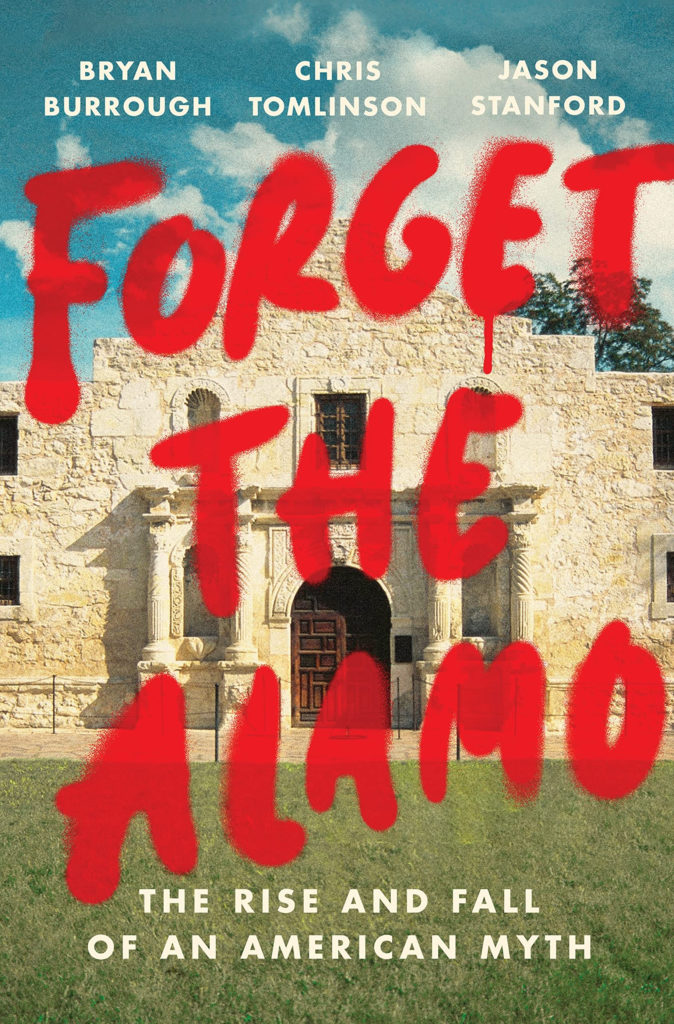
Forget the Alamo: The Rise and Fall of an American Myth
Brand: Boat
For Tabby
... people are viewing this right now
Editorial Reviews Review “Bryan Burrough, Chris Tomlinson, and Jason Stanford urge us to reconsider the Alamo, a symbol we’ve been taught to fiercely and uncritically remember . . . the book provides strong, provocative critiques of U.S. imperialism and colonialism. The myth of the Alamo, as we know it, is a lie. It’s been a part of the lie students have learned in school, and animates the lies peddled by legislation like the 1836 Project and the critical race theory bill. But if you want to truly remember the past, you first have to forget it.” —Texas Observer “Engrossing.” —Wall Street Journal “Lively and absorbing . . . Much of the fun of the book derives from how deftly it strips that varnish off and demolishes the prevailing (white) racist shibboleths—in particular, what the authors call the Heroic Anglo Narrative of Texas history.” —New York Times Book Review “Lively, entertaining and well-researched . . . The greatest surprise of Forget the Alamo is its clear-eyed explication of the ways politicians, educators, writers, filmmakers and TV executives used the Alamo to serve whatever message they were promoting.” —Houston Chronicle “Riveting . . . The narrative flows seamlessly as it explores the complicated legacies of Stephen F. Austin, known as the Father of Texas, and Sam Houston, the first and third president of the Republic of Texas, as well as the many places and institutions named in their honor. Bringing Mexican voices to the forefront, the authors argue that it is necessary to diversify perspectives in order to create a comprehensive historical narrative of Texas, and especially San Antonio. Not only an essential work of Texas history, but popular history at its best. The book shines when detailing the power of telling one’s own story.” —Library Journal “Substantive yet wryly humorous . . . Skillfully drawing on primary and secondary sources, the authors show that Stephen F. Austin, who established a colony of American settlers in Texas in the 1820s, fought to protect slavery from Mexican legislators’ desire to abolish it, and that the independence movement was focused on preserving Texas’s slave-based cotton economy. Enriched by its breezy tone and fair-minded approach, this is an essential look at the Alamo from the perspective of today’s racial reckoning.” —Publishers Weekly “A zesty, journalistic, half history, half sendup about the battle of the Alamo and the myths that cling to it . . . Burrough, Tomlinson, and Stanford, all Texans, succeed brilliantly in their intent . . . this lively book is sure to cause plenty of interesting conversations in Texas. An iconoclastic, romping, bull’s-eye volley at an enduring sacred cow—popular history at its most engaging and insightful.” —Kirkus (starred) “Burrough, Tomlinson and Stanford boldly reappraise a legend that is foundational to Texas, and for that matter to America: the battle of the Alamo. What they’ve unearthed is an astounding century-long effort by the state’s Anglo grandees to repackage an embarrassing defeat as the very fountainhead of Lone Star heroism. Meticulously researched and engagingly written, Forget the Alamo is an all-too-timely tale of how a fable, told forcefully and frequently enough, makes its insidious way into the history books.” —Robert Draper, author of To Start A War“Forget the Alamo is all about myth-busting and icon-smashing. But anyone who thinks that in doing so the authors have simply ruined a perfectly good legend needs to think again. The true story of the Alamo is far more entertaining and complexly human than any amount of John Wayne swinging a musket from the battlements of a Texas fort. This is a ripping good tale, well told.”—S. C. Gwynne, author of New York Times bestsellers Empire of the Summer Moon and Rebel Yell “A clear-sighted historical narrative of the founding story of Texas, full of surprising details that bust the Alamo myths we were taught in school. In a time of real racial reckoning, the heroes of the Alamo don’t get a pass. The authors deliver a page-turner you’ll read with pleasure, packed with insights that stick to your ribs.” —Elise Hu, NPR host-at-large “As a native San Antonian, I grew up knowing only Hollywood’s version of how things went down at what became the ‘shrine of Texas liberty.’ In this lively book, Bryan Burrough, Chris Tomlinson and Jason Stanford dig deep into Texas history to separate fact from legend—not only about the Alamo, but of the forces that produced Texas itself. It turns out reality is richer and more compelling than mythology.”—Karen Tumulty, Washington Post columnist and author of The Triumph of Nancy Reagan About the Author Bryan Burrough is the author of six books, including The Big Rich, Days of Rage, and Public Enemies, and a coauthor of the number one New York Times bestseller Barbarians at the Gate. Chris Tomlinson is a columnist for the Houston Chronicle and the San Antonio Express-News and the author of the New York Times bestselling Tomlinson Hill about his family’s slaveholding history in Texas. From 1995 to 2007, he reported from more than thirty countries and nine wars for the Associated Press. Jason Stanford is a writer and former communications director for the mayor of Austin. As a political consultant, Stanford has helped elect or reelect at least thirty members of Congress. Excerpt. © Reprinted by permission. All rights reserved. Chapter 1 Bloody Texas On March 6, 1836, during what’s been known for almost two centuries as the Texas Revolution, around two hundred men were killed by Mexican troops at an old Spanish church outside San Antonio known as the Alamo. On this we can agree. But after that, pretty much everything-who died, how they died, why they died, and what they represented-has been a topic of debate ever since. Granted, it’s been a gradual thing. For the first 150 years after the battle, few disagreed-at least publicly-with the “traditional” notion that its defenders were fighting for their “freedom” against the “oppression” of a crazed Mexican tyrant, Antonio L—pez de Santa Anna. Lots of folks still believe that. After all this time, you’d think historians would have gotten together and agreed on the facts. Alas, no. We’ll tell you more about this later, but suffice it to say, Texas history, and especially the Alamo’s history, was not a high priority for serious academic study for a long time. A really long time. As late as 1986, in fact, on the occasion of the battle’s 150th anniversary, one noted professor complained that the battle was still awaiting a decent academic analysis. The truth is, the Texas Revolt, as we call it, didn’t attract professional study because, until the last thirty years or so, it was considered hopelessly dŽclassŽ, an academic backwater best abandoned to amateur writers. And so, beginning in the years after the Battle of the Alamo, amateur historians moved in and took over. It is these writers we can thank in part for the fact that the true history of the Alamo, and to an extent the secessionist revolt that led to it, remained obscured by a sooty veneer of myth and folklore. Certainly among American battlefields that attract millions of tourists every year, it remains the least understood. We know almost every intricate detail of Gettysburg, Antietam, and Yorktown, and a lot about Little Big Horn. The Alamo? It’s mostly a guessing game. What was the battle even about? The first professor to study the revolt in the early 1900s floated a strangled argument citing land speculation. The book Anglo Texans have long embraced as definitive, T. R. Fehrenbach’s 1968 Lone Star, argued in favor of “ethnic hatred.” In the fifty years since, most historians have thrown their hands up, chalking it up to “a clash of cultures.” Well, yeah. Let’s stipulate, if you’ll allow, that every “revolution” has two causes: the proximate cause, the trigger that gets folks to fighting, and the underlying cause, the thing that got people so worked up in the first place. The proximate cause in Texas seems pretty clear. For those to whom all this is new, we won’t give that away just yet. (Hint: If you’re a Mexican general who wants to arrest a loudmouthed Texan, don’t bring an army.) It’s the underlying cause that concerns us here. Ignore that and you end up believing the American Revolution was about tea. What, after all, had Texans and the Mexican government been squabbling about for years? Land speculation was part of it, sure, and for some, “ethnic hatred” was too. Anti-tax sentiment played a role, but no one has argued the Texas Revolt was about taxes. Certainly there was a clash of cultures. But the true underlying cause? The thing that got people worked up in the first place? That’s something that still gets people worked up today. At its roots, the Texas Revolt was about money, how Texans made it, and why the Mexican government objected. This line of thinking is neither far-fetched nor dry nor boring. It is solidly grounded in facts, especially the fact of why almost every American came to Texas in the first place: to make money. And make it in a specific way: planting and selling cotton. The story of Texas’s first fifteen years as an Anglo colony is the success story of a band of misfits and dreamers who came to forge sprawling cotton plantations. In just a scant few years, Texas cotton was being made into clothing as far away as England. The “Texians,” as they called themselves, revolted because they believed a new Mexican government threatened this economic model. What was it they feared losing? In the pamphlets and newspaper articles that swirled through the revolt, it was always called “property.” The inarguable fact is that there was only one kind of property the Mexican government ever tried to take from its American colonists, and it tried to do so repeatedly. In the ten years before the Alamo, this single disagreement brought Texians and Mexican troops to the brink of warfare multiple times. So, what did the Mexicans want to take? It wasn’t the cotton. Or the land it was grown on. It was the third leg of the Texas economic stool, the “property” in which Texas farmers had invested more money, more working capital, than any other asset. The slaves. * * * As hard as it may be to accept, Texas as we know it exists only because of slave labor. Southerners-and most Texians came from the South-wouldn’t immigrate to Texas without it. Thousands didn’t, in fact, worried that the Mexican government’s ingrained opposition to slavery put their “property” at risk. For Mexicans, newly freed from Spanish oppression, abolishing slavery was a moral issue. For the American colonists, it was an issue of wealth creation. In the early years, as we’ll see, each new Mexican effort to ban slaves got Texians packing to head back to America. In later years, many put away their suitcases and took out their guns. For more than a century, historians tiptoed around the importance of slavery to the state’s early development. Not until the 1980s did serious academic study of the subject really get under way, led by professors like Randolph B. Campbell at the University of North Texas and Paul D. Lack at Stevenson University. And not until recent years have historians taken the next step, arguing that the need to protect slavery was a driving force behind the Texas Revolt. The most notable book to support this hypothesis, Andrew J. Torget’s groundbreaking 2015 Seeds of Empire, proved enormously influential to our thinking. In these opening chapters, we draw heavily on its conclusions and research. To understand what happened, as Torget demonstrates, it helps to understand how cotton and slavery transformed Texas almost overnight from a blood-drenched semi-wilderness-that’s no exaggeration-into a place where fortunes were made. Talking about the U.S. economy back when this all got started, in the late 1700s, in the era before factories, is a short conversation. There was shipbuilding and whaling in New England, light manufacturing of things like glass and iron ore in the mid-Atlantic states, and a smattering of plantations farming sugar, rice, tobacco, and indigo in Georgia and the Carolinas. None of it was wildly profitable. And then two sets of inventions forever changed America and its economy, especially in the South. The first came in Britain, where advances in cotton spinning, steam power, and iron furnaces led to the first true textile factories, which turned out cotton clothing for people around the world. Then, in 1793, an American tinkerer named Eli Whitney invented the cotton gin, a machine that removes the seeds from cotton; “gin” is short for engine, by the way. Before the cotton gin, a single person using her fingers could clean and produce a pound of cotton a day. Using a gin, she could generate up to fifty pounds a day. The pairing of British textile mills and the cotton gin produced an industrial big bang whose shock waves shook economies around the world. Nowhere was its impact more dramatic than in the American South, whose long, hot summers and fertile river bottoms made it perhaps the single best place on earth to grow cotton. Thanks to the insatiable British appetite for raw cotton-by midcentury, textiles accounted for 40 percent of all its exports-American cotton production exploded. Suddenly all anyone in the South wanted to farm was cotton. Between 1794 and 1800, as Andrew Torget notes, “virtually every tobacco planter in the territory around Natchez, Mississippi, converted his farm to cotton, and in only six years the Natchez District increased its cotton production from 36,000 pounds annually to more than 1.2 million.” But production only truly took off after the War of 1812, when Andrew Jackson defeated the Creek Indians and made Alabama, Mississippi, and Louisiana safe for commerce. When the gun smoke cleared, the government put up for sale fourteen million new acres of prime cotton land-half the size of Alabama-at bargain prices. The price of cotton, meanwhile, soared. This was the beginning of the “Gone with the Wind” South, of landed gentry building columned mansions and plantations. Cotton money made New Orleans the nation’s largest slave port and third-largest city. Natchez was home to more millionaires per capita than New York or Boston. And of course, it was the birth of the slave boom. In 1800, America held almost 900,000 enslaved Black people. By 1860, there would be almost four million. Hundreds of thousands were marched in chains from the mid-Atlantic states to the Gulf Coast to pick King Cotton. Every year more people trundled down the Natchez Trace seeking their share of this fabulous new wealth. Eventually the best land was all taken. What to do? Everyone in the South knew what needed to be done. There were thousands of acres of prime cotton land still available, after all, and all of it could be had for a song. It was right there, so close you could see it, just across the Sabine River on the western edge of Louisiana. In Spanish Texas. * * * Imperial Spain had been one of history’s great bloody empires, its metal-plated conquistadors rampaging across the Americas, crushing the Aztec and Incan empires and chasing tales of treasure from Argentina to Kansas. But by 1800, after two centuries of corruption, inflation, and ill-conceived wars, Spain was the sick man of Europe, its far-flung American colonies bubbling with revolutionary resentments. The remote North American outposts, an archipelago of missions dotting California, New Mexico, Arizona, Texas, and Florida, were limbs on a dying tree, hungrily eyed by ministers in Russia, Great Britain, and the United States. Spain, which hadn’t been able to coax more than a few thousand settlers into its desolate northern reaches, had never had the money or the men to defend them. The Spanish first explored Texas in the 1500s, but for the next two hundred years dismissed it as untenable for settlement, oppressively hot and overrun by hostile Native American tribes. Not until the 1700s, when French traders established a few Texas outposts, did Spain make any real effort to colonize it, chasing off the French and sending priests to open lonely missions at Bexar, today’s San Antonio, and at Nacogdoches in the East Texas pines. Over the years the Spanish succeeded in settling five or six thousand colonists at new towns and missions across the province, but Native Americans killed or chased off almost everyone. By 1800, precisely three towns of note remained. They were sad little places. Nacogdoches, reached by a rutted trail called El Camino Real, was so precarious that settlers abandoned it entirely every few years. San Antonio served as what passed for a capital, twenty-five hundred people, half Spanish soldiers, jammed into a dusty town of sunbaked adobe houses. A hundred miles down the San Antonio River stood La Bah’a del Espiritu Santo, today’s Goliad, with seven hundred people. The entire population of Texas amounted to maybe four thousand men, women, and children scratching out a living on subsistence farming, raising cattle outside San Antonio, and, in East Texas, smuggling anything that would sell to the French settlements in Louisiana. Because Spanish Texas had no port, all supplies had to be walked in from faraway Mexico. From food to rifles, there was never enough of anything. Governors paid off the Native Americans and prayed for the best. The first hint of change came in 1803, when Napoleon sold Thomas Jefferson the French claims on Louisiana and all the western lands between the Spanish settlements and Canada. At the stroke of a pen, America found itself with a new international border with Spain, at the Sabine River. When the two countries set to squabbling over the precise boundary in 1805, both rushed a few hundred troops to the border, but Jefferson decided to let the matter drop. Other Americans wouldn’t. The real trouble began five years later, in 1810, when a crusading Spanish priest named Miguel Hidalgo raised an army of peasants in Mexico intent on overthrowing the colonial government. A year later, rebel soldiers stormed the governor’s house in San Antonio and took him prisoner; La Bah’a and Nacogdoches surrendered without a fight. But two months after that, when Hidalgo’s army disintegrated in Mexico, loyalist Tejanos easily retook San Antonio. The whole thing might have ended there if not for the Americans. Rebels still fighting in Mexico decided to ask for Washington’s help. They sent an emissary named JosŽ Bernardo GutiŽrrez de Lara to Louisiana to meet with the governor, who gave him money and a letter of introduction to the secretary of state, James Monroe. GutiŽrrez proceeded to Washington, where in December 1811 he met with Monroe. The details are instructive given the myriad intrigues that would engulf Texas in coming years. Long story short, every time anyone so much as imagined a revolt in Texas, the authorities in Mexico came to see it as a U.S. government plot. As Monroe’s involvement with GutiŽrrez illustrates, there was ample reason for these suspicions. Monroe, it is clear, was keen to snap up territorial acorns that might fall from the Spanish colonial tree, and if he could shake the tree a little, well, so much the better. In their first meeting, GutiŽrrez wrote in his diary, Monroe agreed to a request for money and arms to invade Texas. He mused about sending an American army to invade Mexico. GutiŽrrez supposedly promised to give him Texas if he did, though GutiŽrrez would later deny it. Afterward, Monroe apparently realized he was getting ahead of himself. In a second meeting he made it clear, apparently without furnishing specifics, that while America remained eager to help, its contributions would be more subtle. And they were, a bit. Two weeks later, GutiŽrrez met with Monroe’s chief clerk, who gave him $200 and a letter asking the Louisiana governor to give him more. When he reached New Orleans, the governor handed him off to a government “commercial agent”-read: spy-who stayed at GutiŽrrez’s side for months, detailing their work together in letters to Monroe. All this amounted to a kind of Bay of Pigs, 1812-style. The staging area for the invasion GutiŽrrez planned was the western Louisiana town of Natchitoches, which served as a kind of log-cabin Miami. To lead his forces, GutiŽrrez hired an army officer named Augustus Magee, who helped raise a motley battalion of 130 or so smugglers, adventurers, and the occasional man of good breeding. Monroe, it’s clear, was briefed every step of the way. From the Publisher